Ink on Camphor Bark Paper · 水墨
逝去与永恒
The Passing and the Eternal
- 材料 Material
- 樟皮纸,水墨 / Camphor bark paper, ink
- 尺寸 Dimensions
- 60 × 80 cm
- 入选 Selected
- 第五届中国当代艺术邀请展 / The Fifth China Contemporary Art Invitational Exhibition
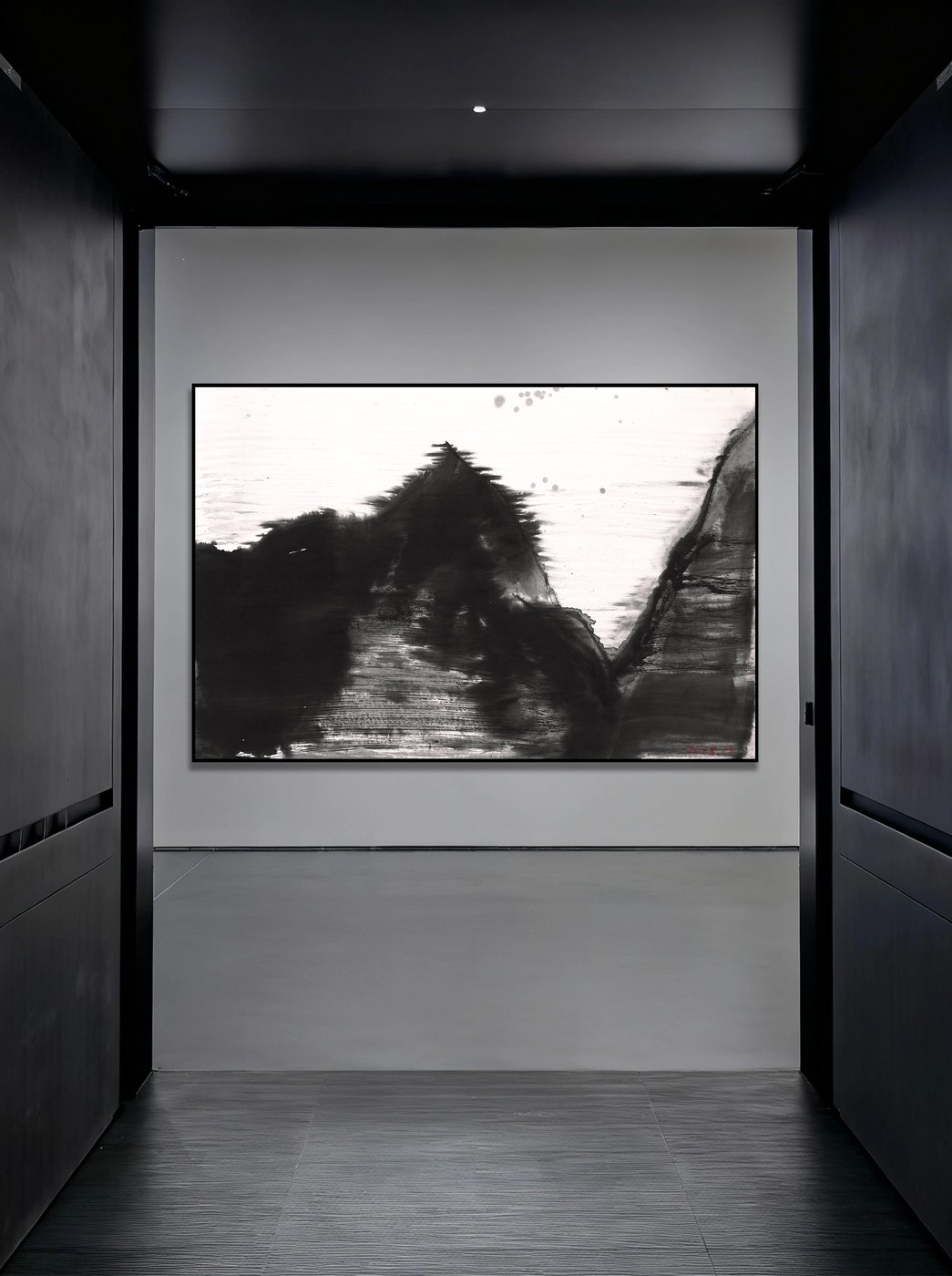
《逝去与永恒》这件作品入选第五届中国当代艺术邀请展,画面下方重墨部分的直观感受是暗中远古苍莽的“峰峦”,实为带有化石层级岩高原的侧面与苔原俯视图的合一,手法类似毕加索的立体派画作侧面与正面合一的人脸。
画面上方并非一无所有的留白,隐约其间有很多横向的淡墨线,代表时间在自然造化中的痕迹,“峰峦”边缘黑色被“化石线条”拉毛的部分代表各种生态与生命,也代表生命对环境和时间的对抗,这呼应了当代大诗人昌耀的名诗《旷原之野》的诗句:“一切为时间所建树、所湮没、所证明。/ 凡已逝去的必将留下永久的信息”,体现了陈龙“诗画互证”和对艺术作品“诗意”的追求。
作品中不同层次与肌理的积墨与坚挺的樟皮纸之间的浸染渗透,也是颜料矿物与纸材植物之间的相互作用,是潜在的自然与时间的互动关系,体现了生命的“变”与地质的“不变”,以及时间与自然的“消融”状态,表现“逝去”的现代绘画语言与表现“永恒”的传统山水笔触的融合,也体现了诗人昌耀诗歌中现代性与古典精神的融合。这幅作品可视为是与诗人昌耀书写西北的互文作品。
This work was selected for the Fifth China Contemporary Art Invitational Exhibition. The heavy-ink section at the lower part of the image gives the immediate impression of dark, ancient, and vast "mountain peaks," but is in fact a fusion of the profile of a fossil-layered rocky plateau and a top-down view of tundra—employing a technique similar to Picasso's Cubist paintings, in which the profile and frontal view of a face are united.
The upper part of the image is by no means an empty blank space: faintly discernible within it are many horizontal pale-ink lines, representing the traces of time in the workings of nature. The frayed edges where the black of the "mountain peaks" is pulled apart by "fossil lines" represent various ecosystems and life forms, and also represent life's resistance to environment and time. This echoes a line from the famous poem The Vast Wilderness by the great contemporary poet Chang Yao: "All that time has built, buried, and proven. / Whatever has passed away will leave behind eternal information." It embodies Chen Long's pursuit of "poetry and painting as mutual proof" and the "poetic quality" of artistic works.
The seepage and permeation between the layered ink washes and textures of varying density and the firm camphor bark paper is also an interaction between mineral pigments and plant-based paper material—a latent interactive relationship between nature and time, embodying the "change" of life and the "unchanging" quality of geology, as well as the "dissolving" state of time and nature. It expresses the fusion of a modern painting language that conveys "passing" with traditional landscape brushwork that conveys "eternity," and likewise embodies the fusion of modernity and classical spirit in the poetry of Chang Yao. This work may be regarded as an intertextual companion piece to the poet Chang Yao's writings on the Northwest.